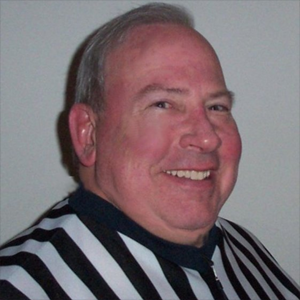
Rndballref
20 Years Experience
Chicago, IL
Male, 60
For twenty years I officiated high school, AAU and park district basketball games, retiring recently. For a few officiating is the focus of their occupation, while for most working as an umpire or basketball referee is an avocation. I started ref'ing to earn beer money during college, but it became a great way to stay connected to the best sports game in the universe. As a spinoff, I wrote a sports-thriller novel loosely based on my referee experiences titled, Advantage Disadvantage
A referee can order the scorer to change something in the book, if and only if the offical has direct knowledge that there is an error in the book. For example, if the ref knows a shot was called a 2 point shot but the scoreboard and book have it as a 3, the ref can get it changed. So in your question it depends on whether the coach brought something to official's attention that the ref knew without doubt was correct, he can change it. But if the ref got bullied by the coach into changing something the ref is not 100% positive then the ref should not work any games anymore.
Share Answer: 

Assuming that you have an excellent understanding of the rules and good judgement as to when to apply them, then if a coach has a disagreement and you feel it needs to be addressed:1) approach the coach. "Coach you disagree with that call. Tell me, what did you see?"2) after the coach tells you, you say "Coach, I saw that the play happened a different way. Here is what I saw … . but if the play happened the way you saw it, then I missed it."3) don't be afraid to admit that you booted a call occasionally. "Coach, in replaying the action in mind, you might be right and I may have called the wrong thing." But don't become a perpetual apologist. 4) if the coach perpetually is riding you and is never satisfied with your explanations, then you need to tell him/her that you have heard enough. their complaints are getting in the way of you doing your job. Some officials tell you to hold an open hand up after you have warned him - they call this officiating to the tape because if you end up throwing a coach out of a game, the assigner can look at the tape and corroborate your review which included a verbal and hand warning.5) have thick skin. the tough guys who are too sensitive about valid criticism never advance very far in officiating. In 20 years of high school officiating I have thrown out of games only 4 or 5 coaches.
As for parents, my best advice is to ignore them. If they shout inappropriate things (threats or derogatory remarks) have home management eject them. No good will come from trying to educate a biased fan who has little grasp of the rulebook. However, I have answered questions after a game from parents who approach respectfully.
Share Answer: 
No. The coach of the injured player decides who to put in.
Share Answer: 
You can buy the basketball rules books (rules, case book, officials manual) at the National Federation of High Schools website:
www.nfhs.com/c-195-basketball.aspx
You can look at the NBA rules at their website:
www.nba.com/analysis/rules_index.html
You can download NCAA rules at their website:
www.ncaa.org/championships/playing-rules?division=d1
Share Answer: 
School Teacher
 Do you think teachers are underpaid? Why?
Emergency Room Manager
 What's the best time to arrive at an ER to avoid waits?
Videogame Reviewer
 Pick one: Nintendo Ice Hockey, NHL ‘94, or Blades of Steel?
Let me preface my answer by reminding you that I am an advocate of the Advantage Disadvantage philosophy of officiating basketball. This philosophy advocates not stopping play to call a foul or a violation unless that action causes a change in the balance of the defense/offense posture.
So, I tended to call very few 3 seconds in varsity basketball. For me it was usually a late call, as in a player is camped in the lane and gets the rebound, I would call a late 3 seconds call. If he didn't get the rebound play on. But since play goes so fast, premptive officiating would suggest warning the player to get out of the lane before having to make an advantage/disadvantage decision.
This is controversial in 2 ways: 1) you are right that at the varsity level players should not be "coached" by the ref's, and 2) not everyone believes in advantage/disadvantage.
I would warn a player once to stop him from camping out in there, but I am an advocate of advantage disadvantage officiating.
Share Answer: 
Team control ends when there is a try or tip, an opponent secures control, or the ball becomes dead. Hitting the hand of player B does not constitute control so I would say if the ball is picked up by team a in the backcourt it is a violation.
Share Answer: 
No it is not a proper box out. Boxing out is when a defender moves legally to a space that an opponent is trying to get to, thereby boxing him out. Using your arm to create space (whether by the offense or defense) is a foul.
Share Answer: 
-OR-
 Login with Facebook
 (max 20 characters - letters, numbers, and underscores only. Note that your username is private, and you have the option to choose an alias when asking questions or hosting a Q&A.)
(A valid e-mail address is required. Your e-mail will not be shared with anyone.)
(min 5 characters)
By checking this box, you acknowledge that you have read and agree to Jobstr.com’s Terms and Privacy Policy.
-OR-
Register with Facebook(Don't worry: you'll be able to choose an alias when asking questions or hosting a Q&A.)



 Browse Jobs
 Host a Q&A
 Search

 Submit Your Question
 Host a Q&A
 Last 7

