Factor
Woodstock, VA
Male, 65

My life in ATC began with 4 years Air Force then another 30 years with the Federal Aviation Admin. working tower & radar at some big international airports. I fought in the 1981 war with PATCO, survived the strike and kept a job that was just too exhilarating to walk away from. While there was nothing better than working airplanes, I did move on through several air traffic supervisory and management positions. It was a long, crazy career but I wouldn't trade a moment of it for love or lucre!
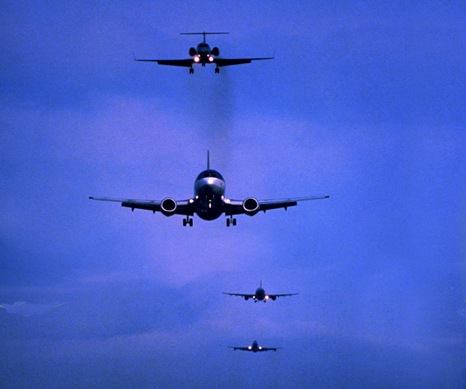
Another great question! With the exception of military aircraft on special missions, no aircraft are permitted to exceed 250 knots while operating below 10,000 feet. The Federal Aviation Administration also prohibits any supersonic flight over land, regardless of altitude, except in special military flight corridors. These rules make it a lot easier for controllers to handle aircraft of various performance capabilities. When possible, smaller aircraft that operate at much lower speeds than jet and turboprop powered flights are routed differently; along with other flights of more compatible performance characteristics.
Air traffic controllers may also use speed control; instructing pilots to adjust their aircraft’s speed as a way of achieving and/or maintaining required spacing from other aircraft. If speed control doesn’t quite do the job, we can also assign delaying vectors to aircraft in danger of getting too close to the traffic they are following. Speed control and vectoring are among the most essential tools of a controller's trade.
Thanks for asking!
Factor
Share Answer: 

Thanks for writing! Before answering, I should say that pilots and controllers rarely disagree. Although we’re working at different ends of each radio transmission, we’re all on the same team when it comes to safe, efficient flight. When those occasional conflicts arise, flight safety and/or efficiency is most likely at the bottom of it.
Pilots are the final decision makers when it comes to doing what’s best for plane and passenger. The best example I can think of is the “Miracle on the Hudson” when US Airways flight 1549 landed in the river. Once made aware of the flight’s engine failures, air traffic control first tried to get the flight back to La Guardia Airport, then to Teterboro Airport. The pilot refused both options and landed in the Hudson River. As it turned out; he did the best thing.
Another, more general example would be when there are thunderstorms in the area. The radar controller may assign a heading to a flight that the pilot will refuse to comply with. Why? That heading would turn the aircraft into some potentially severe weather. Nobody argues. The controller just has to quickly come up with a “Plan B.” This is a fairly common occurrence during thunderstorm season. Although ATC usually has plenty of radar weather information available; it’s not the same as actually seeing and experiencing it from a cockpit! Well informed as they are; controllers can’t feel the plane shaking.
Basically, a controller’s instructions are not optional. Compliance is expected because it’s a mainstay of aviation safety. However, there are those rare exceptions. When pilots deviate from or fail to comply with instructions; they may be asked to contact the controlling ATC facility after landing, to explain the matter.
I hope this helps!
Factor
Share Answer: 
Interesting question! Yes, it happened one night several years ago when I was on duty in an Air Force control tower. A fellow airman and I were working the midnight shift. It was probably around 3:00 AM and all the planes had long since landed. There was nothing left to do but stare out of the tower windows and talk about the latest squadron gossip. It turned out there would be something to do!
At first, I thought I was “seeing things.” It was a long string of glowing lights, like the passenger windows on an airliner, moving silently across the airfield at nearly treetop level. Only about a mile away, it was moving way too slowly to be an airliner. We figured it was some kind of aircraft though, so we tried calling on all our tower radio frequencies; including the emergency frequencies that pilots switch to when they’re having difficulties. No reply. Then we called the Base radar control facility and asked the controller if they were working any planes near the airport. They were not. Nor did they see any radar targets anywhere in the area. That’s when we figured this was an extraordinary event. I mean, we were standing in the tower watching this thing!
We watched the object move across the field and eventually vanish in the distance. Later on, we called a couple of the nearest FAA air traffic control facilities and asked them if they had received any reports of unusual activity in the skies. The supervisor at one facility told us there had been several reports made by airline pilots who claimed they saw what looked like a low flying, slow moving aircraft heading in the same direction that our thing was moving. Their reports came in about an hour or so after our siting at the base.
The Air Force actually had a program in place at the time called “Project Blue Book” wherein they collected and supposedly analyzed UFO reports. We had the reporting forms in the tower but decided not to fill one out that night. In spite of what we were told, everyone was worried that filling out the report would make them look like ‘whackos’ who’d never be promoted again! Me and my mid-shift buddy agreed to never mention the incident to anyone. To this day I have no idea what we saw that night but somebody out there probably does.
Cheers,
Factor
Share Answer: 
That’s a difficult one to answer! Overall, the United States, by far and away, contains the most airports. There are more than 20,000 of them, which makes managing our National Airspace System such a challenge for the Federal Aviation Administration. Pennsylvania alone has over 800 airports compared to the 65 or so found in China. The only other countries that begin to approach U S. numbers are Brazil, with about 2,930 airports and Canada with 1,865.
The busiest air traffic control systems on U.S. soil are associated with major metropolitan area airports. You’ll find your fill of airplanes around Atlanta, Chicago, Los Angeles, Dallas, Denver, New York, San Francisco, Las Vegas, Charlotte and Phoenix. Traffic volume in these areas is largely due to airline hub operations at key airports. Air traffic controllers who work there have to love their work. There’s so much of it to love!
Cheers,
Factor
Share Answer: 
Zookeeper and Animal Trainer
 Which cuddly-seeming animals are actually dangerous to be around?
Professional Reseller
 What was your most valuable find in a thrift store?
TV Meteorologist
 Is having a weatherman really better than just throwing to a 5-day forecast screen?
Thanks Jen. I really enjoy the high quality questions I’m getting. These two are pretty challenging because I have to look back on 34 years of bad decisions and big mistakes. I guess I was lucky the bad decisions never got me fired and none of my big mistakes ever made the Six O'clock News!
Controllers are certain to make a bad decision once in a while. Most of the time it’s not the end of the world. Maybe you simply cleared an aircraft onto a runway for takeoff when the next arrival was too close to touching down. Maybe it was a bad vector that put one plane too close to another. Or perhaps it was deciding to call in for sick leave so you could take your wife out to dinner. Then guess what? The Facility Manager and his wife show up at the same restaurant. He sees you and asks why you aren’t at work. You know; stuff like that. You weather the storm, add another lesson learned to your growing list, pound the dents out of your ego and move on.
I suppose the single worst decision I made was to leave my position as a controller in pursuit of a career in Management. Once I launched onto that trajectory, it was hard to turn back. Making my way though a staff specialist job, operational Supervisor, shift Manager, then on to several Staff Manager positions - the work was always exciting and challenging. The work, however, was not the problem. Problems arose from some of the people I worked for or with along the way. I can’t speak for today’s FAA but during my career, Management seemed top heavy with ego maniacal, power hungry back-stabbers. But why dwell on their good points? Controllers have the best job in the FAA and, in retrospect, I probably shouldn’t have traded my headset for a desk set.
Was I ever reprimanded? Of course. In a job that leaves no margin for error; we’re all bound make them now and then. Good Managers know how to handle such things without demoralizing the offender. Fortunately, there were a few good Managers in my career. Looking back, they are the one’s I learned the most from.
Cheers,
Factor
Share Answer: 
Thanks for reading my responses! I’m glad you’re enjoying them.
ATC can put all kinds of things besides airplanes into motion but the two you mentioned are not among them. We don’t have “red alerts” but every tower I’ve been in (including military towers) has a red phone. It’s an emergency circuit and is activated by simply lifting the receiver. We use it whenever there is or soon will be an emergency situation on or near the airport. The circuit rings at all the places you’d expect; like the airport police, fire & rescue, airport operations and anyone else with an immediate need to get involved. The circuit is tested once daily, at a pre-determined time so that everyone knows it’s a test. Any other time you pull that phone; expect to see all kinds of emergency response vehicles pouring out across the airfield toward the location we’ve described.
I assume “Thor Guard” pertains to thunderstorms or other severe weather phenomena. If so, I can tell you that controllers are very well informed about current and forecasted weather. Most have several radar tools at their immediate disposal, plus FAA staffed weather units in all the ARTCCs (Air Route Traffic Control Centers) and several other information sources to help ATC personnel decide how best to handle the air traffic.
If I misunderstood the question and you are actually asking whether controllers can initiate a 9/11 type of response like scrambling fighter jets, etc.; the answer is – not directly. Controllers will likely be the first to recognize such a situation developing. If so, they will quickly alert supervisory personnel and the information will be immediately forwarded to appropriate authorities for further action.
I hope I answered your question!
Cheers,
Factor
Share Answer: 
This is an important question. I’ll attempt to answer it with callous objectivity - tainted by a sprinkling of subjective sentiments and a smidgen of erratic rationale. Always the controller.
The Country actually needs more controllers at the busiest FAA facilities and fewer to none at the less active locations. I would suggest a redistribution of resources except for the fact that controllers from the closing towers are not FAA employees. They work for private air traffic control services under contract to the FAA; the same FAA who pays them around a half million of our tax dollars per year, per tower. The airports these contract controllers work at did not meet the threshold in air traffic volume to justify an FAA tower. While I hate to see anyone lose their job; I’d say that closing these towers is “a healthy trimming of fat.” They are a legacy of better times.
The “scary reduction in safety” card is being played mainly for political purposes. One Congressman stated; “Closing control towers is equivalent to removing stop lights and stop signs from our roads...” This is not only a bad analogy but isn’t even amusing hyperbole. Closing those towers will be more like adding a few small speed bumps to air traffic operations. While some operations at these airports may be slowed down a bit; safety won’t be compromised. I’ll note here that all pilots are trained in how to conduct flight operations at uncontrolled (no tower) airports. Controllers are too. I worked at two busy radar facilities that had control jurisdiction over dozens of towerless airfields. Operations were conducted efficiently and with no derogation of safety.
Closures are slated to occur at low density airports with less than 150,000 takeoffs and landings per year. Doing the math; that amounts to a little over 400 aircraft movements in a 16 hour day (assuming no midnight shift) or about 25 takeoffs and landings per hour. In comparison, Atlanta Hartsfield Airport averages around 2,500 operations a day. If airport operators, users and other interested parties feel strongly enough about keeping their particular tower open, I suspect they could approach their State and/or local government about funding it.
Cheers,
Factor
Share Answer: 
-OR-
 Login with Facebook
 (max 20 characters - letters, numbers, and underscores only. Note that your username is private, and you have the option to choose an alias when asking questions or hosting a Q&A.)
(A valid e-mail address is required. Your e-mail will not be shared with anyone.)
(min 5 characters)
By checking this box, you acknowledge that you have read and agree to Jobstr.com’s Terms and Privacy Policy.
-OR-
Register with Facebook(Don't worry: you'll be able to choose an alias when asking questions or hosting a Q&A.)



 Browse Jobs
 Host a Q&A
 Search

 Submit Your Question
 Host a Q&A
 Last 7

